The project implements integrated flood infrastructure from the Museum of Jewish Heritage through Wagner Park and along the border of the historic Battery
Reopened Battery Bikeway offers dedicated cycling path along the tip of Manhattan and features scenic coastal views
Download photos here
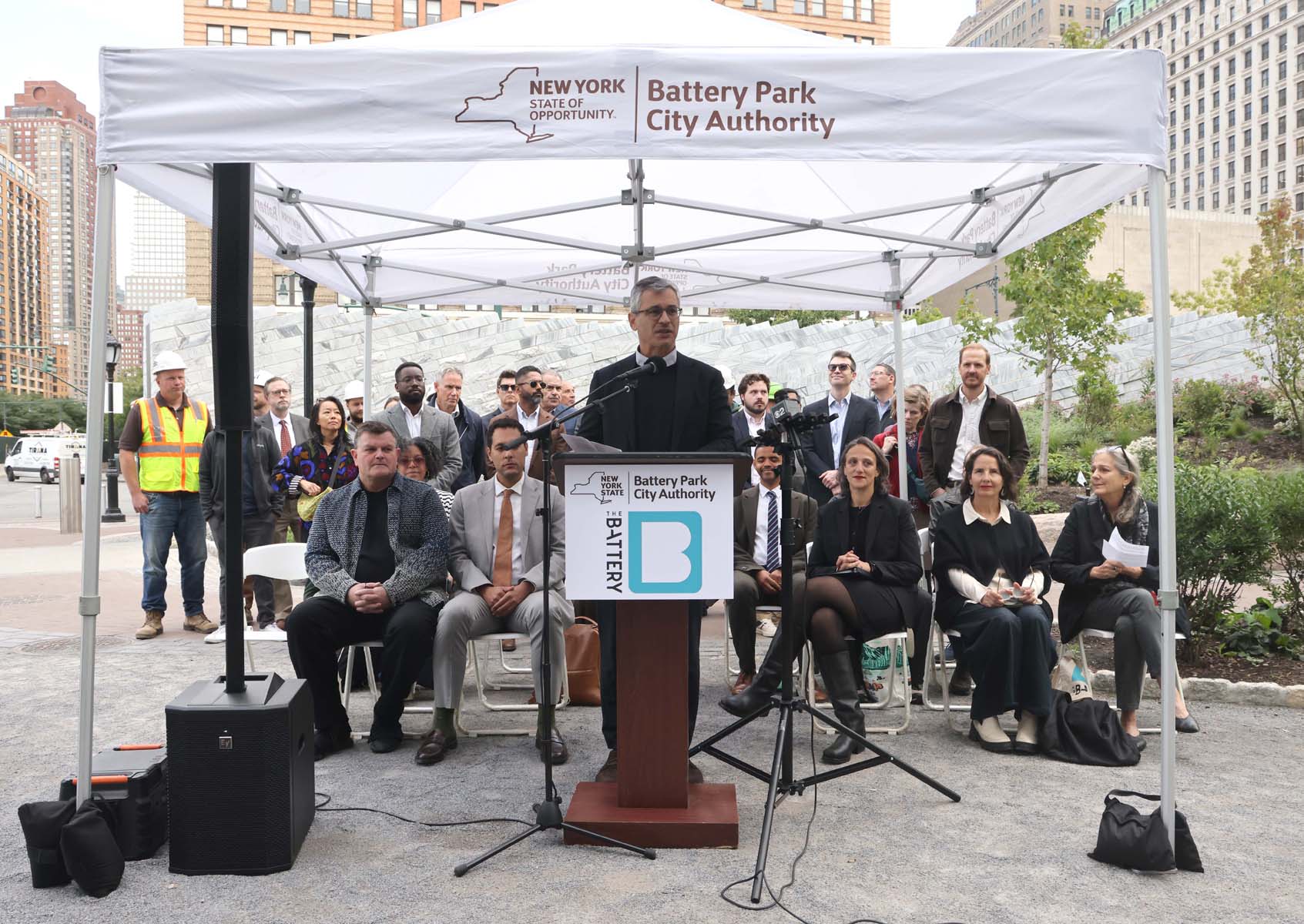
The Battery Park City Authority (BPCA), The Battery Conservancy, elected officials, and community partners today celebrated the completion of the South Battery Park City Resiliency Project (SBPCR) during Climate Week. To mark the milestone, an event was held to open the restored Battery Bikeway, a dedicated cycling path with scenic views for riders traversing Manhattan’s southern tip. SBPCR creates an integrated coastal flood risk management system from the Museum of Jewish Heritage, through Wagner Park, across Pier A Plaza, and along the northern border of the historic Battery and represents one of several projects within the overall Lower Manhattan Coastal Resiliency (LMCR) Master Plan.
“The completion of the South Battery Park City Resiliency Project delivers critical flood protection while creating a more vibrant public space for New Yorkers and visitors to enjoy,” said Governor Kathy Hochul. “As we continue to build a more resilient Lower Manhattan, projects like this will help safeguard our coastline, support quality of life and prepare New York for the future.”
“With completion of the South Battery Park City Resiliency Project we’re proud to deliver an integral component of the Lower Manhattan Coastal Resiliency initiative,” said Battery Park City Authority Chair Don Capoccia. “The work represents a vital and historic investment in downtown Manhattan – in its people, its infrastructure, and its public spaces. I thank the BPCA team, our partners at the Battery Conservancy, our local elected officials, and the range of community stakeholders who have come together to effectuate a more resilient future.”
“From the unveiling of Wagner Park last July to the official reopening of the Battery Bikeway today, SBPCR represents years of hard work to make Lower Manhattan more resilient, and we are excited to celebrate its culmination with our partners and supporters,” said Battery Park City Authority President & CEO Raju Mann. “As we continue delivering a more sustainable Lower Manhattan through our North/West Battery Park City Resiliency Project, SBPCR serves as an example of how resiliency work can also lead to better public spaces and infrastructure for the community.”
“The contours of The Battery are changing to meet the challenges of storm surge and sea-level rise, while preserving the beauty and character of this extraordinary public space,” said Paula Recart, President of The Battery Conservancy. “We thank our partners at BPCA for showing that resilience infrastructure can also be beautiful – and we’re thrilled to welcome cyclists back to our uniquely gardened Bikeway connecting Manhattan’s west and east sides.”
“The completion of the South Battery Park City Resiliency Project is a defining investment in the future of Lower Manhattan,” said Assemblyman Charles D. Fall. “For years to come, these protections will help safeguard residents, businesses, public spaces and the community we’ve built along this waterfront. I’m proud to celebrate a project that gives our neighbors greater security today while ensuring Battery Park City remains strong, resilient and vibrant for generations to come.”
“The completion of the South Battery Park City Resiliency Project brings new flood protection to our waterfront, from the Museum of Jewish Heritage through Wagner Park and along the Battery,” said Council Member Christopher Marte. “With the Battery Bikeway reopening, residents, commuters, and visitors will also regain a dedicated cycling connection along the southern tip of Manhattan.”
“Completing the South Battery Park Resiliency Project strengthens Manhattan’s southern shoreline against the growing risks of climate change and rising seas,” said Department of Environmental Protection Commissioner Lisa F. Garcia. “DEP was proud to partner with BPCA, underscoring our commitment to collaboration in tackling New York City’s coastal challenges. This integrated defense system will help ensure Lower Manhattan remains a safe, resilient public space that can better withstand severe weather.”
“NYC Parks is proud to work alongside our partners at the Battery Park City Authority and The Battery Conservancy as we continue to build a more resilient and vibrant Lower Manhattan,” said NYC Parks Commissioner Tricia Shimamura. “Today’s reopening of the Battery Bikeway marks an important milestone in strengthening Lower Manhattan’s waterfront while making it more accessible and enjoyable for New Yorkers. From resilient infrastructure to welcoming public spaces and a connected waterfront network, this project demonstrates how we can prepare our city for the future while enhancing the ways New Yorkers experience their parks and public spaces.”
“The completion of the Battery Park Coastal Resilience project marks an important milestone in protecting Lower Manhattan residents from flooding when the next storm comes,” said New York City Chief Climate Officer Louise Yeung. “The reopening of the Battery Bikeway as part of this project shows how we can pair critical flood protection with better, more connected public spaces. This effort is an important part of the broader suite of Lower Manhattan Coastal Resiliency projects, and serves as a model for how we can build a waterfront that is safer, more accessible, and ready for the future.”
“Today marks an important milestone for Lower Manhattan,” said Alice Blank, Manhattan Community Board 1 Chair. “CB1 congratulates the Battery Park City Authority, The Battery Conservancy, and the many partners who have worked over the years to bring this project to completion. The completion of the South Battery Park City Resiliency Project represents a significant step in strengthening Lower Manhattan against coastal flooding, while the reopening of the Battery Bikeway restores a scenic connection along our waterfront. CB1 looks forward to continuing to work with BPCA, The Battery Conservancy, and our community to build on this progress and ensure that Lower Manhattan’s waterfront remains a vibrant and welcoming public resource.”
“The completion of the South Battery Park Resiliency Project marks a significant moment for New York’s continued investment in its green infrastructure, along with the family-sustaining union careers this project has created for hardworking New Yorkers,” said Gary LaBarbera, President of the Building and Construction Trade Council of Greater New York. “Not only will a significant portion of Lower Manhattan now be reinforced against flooding, but more tradesmen and tradeswomen will also have had the opportunity to pursue the middle class. We congratulate the Battery Park City Authority on this milestone and look forward to continuing our collaboration as we move to complete the North/West Battery Park City Project.”
“As extreme weather becomes more frequent and sea rise inexorable, this milestone in the South Battery Park City Resiliency Project is a big step forward,” said Jessica Lappin, President of Downtown Alliance. “The progress at the Battery is an important accomplishment and sets an encouraging example for other coastal communities facing similar challenges here in New York and in the nation.”
“The Battery is an essential gateway to the Statue of Liberty and Ellis Island, welcoming millions of visitors each year,” said Jesse Brackenbury, President and CEO of the Statue of Liberty & Ellis Island Foundation. “This important resiliency work will help protect this historic waterfront while creating a safer and more welcoming experience for generations to come.”
“Nearly 14 years ago, the devastation brought by Superstorm Sandy – including record-breaking flooding in and around Battery Park City – sparked a wave of planning, design, and construction efforts to make the waterfront edge and the communities along them more resilient to coastal flooding,” said Robert Freudenberg, VP, Energy & Environment and Regional Plan Association. “Today, we join the BPCA, the Battery Conservancy and all of the other partners and supporters involved in celebrating the completion of the South Battery Park City Resiliency Project, which, with the reopening of the Battery Bikeway and prior park improvements, demonstrate that when done right, resilience projects can keep the water out while letting the public in.”
“The completion of the South Battery Park City Resiliency Project is another major step toward protecting New York City’s coastline from flooding and the accelerating impacts of climate change,” said Patrick McClellan, Policy Director, New York League of Conservation Voters. “This milestone shows what effective, community-driven climate planning can achieve – and as we near the 14th anniversary of Superstorm Sandy, it’s a clear signal that New York can rise to the challenge. NYLCV congratulates The Battery Park City Authority and The Battery Conservancy on the completion of this project, and we urge the city to act with urgency to shore up the rest of Lower Manhattan’s coastlines.”
“We’re excited to see construction work starting on the North/West Battery Park City Resiliency Project, which will strengthen resilience across Lower Manhattan,” said Kate Orff, SCAPE Founding Principal and Partner. “The project weaves critical new flood protection infrastructure together with public realm improvements and a revitalized landscape.”
“Congratulations to the Battery Park City Authority and The Battery Conservancy on the completion of the South Battery Park City Resiliency Project. This milestone demonstrates how resilient infrastructure can be successfully integrated into the urban environment to help protect Lower Manhattan,” said Joseph Marrone, Arcadis Senior Vice President and Design Lead for the North/West Battery Park City Resiliency Project. “Arcadis is proud to support BPCA and Turner SPC in advancing the North/West Battery Park City Resiliency Project and a more resilient future for New York City.”
“With construction underway on the North/West Battery Park City Resiliency Project, we’re proud to be advancing an important piece of New York’s resiliency efforts – strengthening the city’s waterfront while creating more accessible and welcoming public spaces in Lower Manhattan, said Daniel Sundlin, Partner, BIG-Bjarke Ingels Group. “Building on the vision of the BIG U, the project shows how protective infrastructure can become social infrastructure – both safeguarding New Yorkers and integrating into the everyday life and landscape of the city.”
“At LiRo-Hill, we pride ourselves on delivering high-quality complex infrastructure and park projects,” said Laura Gray, Senior Vice President at The LiRo Group. “We are honored to play a central role in protecting Lower Manhattan through this vital, complex coastal resiliency initiative.”
“The Battery Park Constructors team and the BPCA LiRo team worked really well together,” said Michael Capasso, President, CAC and Partner, BP Constructors. “Dense urban environment jobs always face significant challenges and when issues arose on the site all the stakeholders worked really well together to find solutions to keep the project moving along. Often there is contention and this project there was outstanding teamwork from all parties.”
The Battery Bikeway connects the Hudson River Greenway to the East River Esplanade and passes through the length of Battery Park City. It is part of an uninterrupted 31-mile waterfront bicycle path around the perimeter of Manhattan. The reopening of the Battery Bikeway provides cyclists with a safe and scenic route to traverse the borough’s perimeter.
SBPCR significantly improves the area’s flood infrastructure, with certain areas of the project zone sitting at the lowest elevation in the park and needing robust flood protections. Much of the flood infrastructure is buried underneath an elevated planting area, integrating seamlessly into the park landscape. The infrastructure includes open and buried floodwalls and flip up gates.
Previous SBPCR milestones include the reopening of Wagner Park last July, the unveiling of the Wagner Park Pavilion rooftop last fall, and completion of the Wagner Pavilion Classroom earlier this year. The delivery of the 3.5-acre public park located along the Hudson River has significantly fortified the neighborhood against coastal flooding while also creating beautiful new public green space, a 1,200 square foot venue for community use, and a rooftop garden with sweeping views of the Statue of Liberty and skyline.
Components of the completed SBPCR Project include:
– Elevation of Wagner Park and Pier A Plaza to above the projected flood levels
– Renovation of Pavilion at Wagner Park with a zero-carbon facility certified by the International Living Future Institute (ILFI)
– Flood walls and deployable flood gates
– Improvements to storm drainage systems serving the project site to reduce flood risks
– New landscaping features and plaza components
– Installation of a storm-water retention cistern
– Enhancements to street-side site security along Battery Place
– Modifications to the inlet at Pier A and associated waterside edge conditions
– Creation of a physical tie-in between the SBPCR Project and the Battery Coastal Resilience Project
Where SBPCR leaves off, BPCA has also started work on the North/West Battery Park City Resiliency Project (NWBPCR), which will extend north from the Museum of Jewish Heritage to Greenwich Street in Tribeca. Led by the Turner Construction Company–SPC Construction Co. LLC joint venture and designed by Arcadis, BIG, SCAPE Landscape Architecture, and others, NWBPCR features an interconnected series of fixed flood barrier features and deployable measures to provide flood protection for the balance of Battery Park City and western Tribeca. To better limit areas of residual flooding within the study area, the project also proposes to manage rainwater flooding by incorporating improved drainage connections and upgraded tide gates.
Back to Blog Homepage