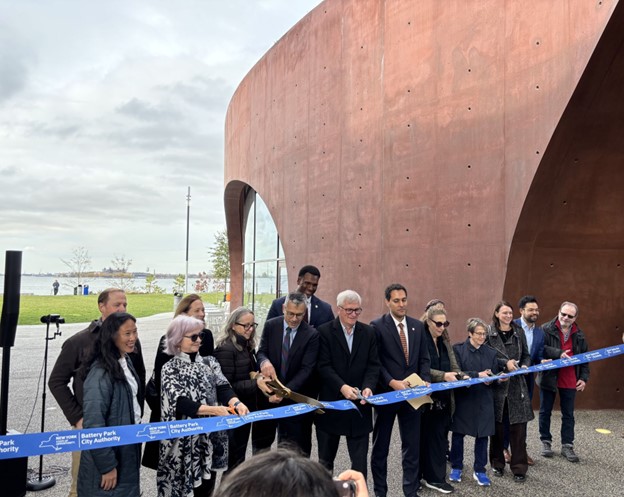
New publicly-accessible rooftop offers sweeping views of the Statue of Liberty, Ellis Island and Hudson River, complementing the new Wagner Park
Marking 13th anniversary of Superstorm Sandy, the new structure is a model for resilient coastal infrastructure
Battery Park City Authority (BPCA) with local elected officials, community leaders, and project partners last week celebrated the opening of the Wagner Park Pavilion, the central structure of the new Robert F. Wagner, Jr. Park, which reopened in July after a major reconstruction to address urgent climate resilience needs. The centerpiece of BPCA’s South Battery Park City Resiliency Project, and part of New York City’s overall Lower Manhattan Coastal Resiliency Project (LMCR) to aimed at reducing flood risk due to coastal storms and sea level rise in Lower Manhattan, the Pavilion’s rooftop garden offers sweeping views of the Statue of Liberty, Ellis Island and Hudson River, and new restrooms are now open to the public. A classroom/community space will debut within the pavilion early next year, and with a restaurant to follow in Summer 2026.
“Opening the Wagner Park Pavilion reminds us of the reality that underlies this significant milestone in BPCA’s ongoing resiliency work,” said BPCA President & CEO Raju Mann. “Not only are we dedicated to creating a more resilient Lower Manhattan that can withstand the storms to come, we also want to create beautiful public spaces for all to enjoy – two goals perfectly encapsulated in the new Pavilion. As we celebrate the Wagner Park Pavilion, we look forward to continuing our work through the North/West Battery Park City Resiliency Project.”
“Thirteen years after Superstorm Sandy, Battery Park City’s new Wagner Park Pavilion is a model for how New York can adapt, protect our communities, and preserve our waterfront for generations to come, said Congressman Dan Goldman. I’m proud to see this vision come to life, and grateful to the Battery Park City Authority, who helped get this fantastic public benefit across the finish line.”
“The Wagner Park Pavilion is a powerful testament to New York’s ability to meet the climate crisis head-on while creating extraordinary public spaces,” said Manhattan Borough President Mark Levine. I’m thrilled to celebrate this milestone with Battery Park City residents and all New Yorkers who will enjoy this destination.”
“Reopening Wagner Park reminds us of the importance of strengthening our shorelines and investing in resiliency,” said Assemblyman Charles D. Fall. “I want to thank the BPCA for its continued dedication to ensuring that the community can safely enjoy Wagner Park for generations to come. I look forward to seeing all the community events and gatherings that will bring this new, weather-resilient space to life.
“I’m glad to be celebrating the opening of Wagner Park Pavilion as a touchstone of the BPCA’s ongoing commitment to fortifying coastal resiliency, said Assemblymember Deborah J. Glick. “As we note the 13th anniversary of Superstorm Sandy, we are reminded of how essential it is to protect our waterfront in Lower Manhattan against the increased flooding and storm surges that come with climate change. I applaud the BPCA for their great work in Wagner Park and the Lower Manhattan community for their thoughtful engagement as we eagerly await the rest of the work being carried out through the North/West Battery Park City Resiliency Project.”
“Thirteen years after Superstorm Sandy, this milestone reminds us not only of what we’ve built, but of what remains at stake,” said Council Member Christopher Marte. “We cannot afford to lose the momentum that followed Sandy. As sea levels rise and storms grow stronger, we must be more intentional and coordinated in building true coastal resiliency. The new Wagner Park Pavilion shows what’s possible when design, community, and climate action come together—and we need to carry that same commitment to protect all of Lower Manhattan.”
“Manhattan Community Board 1 is delighted to celebrate the opening of the Wagner Park Pavilion rooftop, a welcome addition to the public spaces for everyone to enjoy,” said Tammy Meltzer, Chair of Community Board 1. “The accessible rooftop offers the public an extraordinary vantage point over New York Harbor while preserving what makes Battery Park City so special, its beautiful public open spaces. We are looking forward to the upcoming opening of the classroom and community room soon as a place to learn about our city’s resiliency initiatives, serve as a gathering place for the community, and provide a place for shelter from inclement weather. The addition of public restrooms and the forthcoming restaurant will further enhance this park as a welcoming destination for residents and visitors alike. Wagner Park and its public spaces are part of what makes Battery Park City such a special place in Lower Manhattan.”
The new Wagner Park Pavilion, designed by Thomas Phifer and Partners, serves as a beacon of the park, crowning the top of two sloped gardens. Visitors can approach the pavilion from either Battery Place or the waterfront esplanade by ascending the accessible ramps and stairs. Arched vaults welcome the public to the entry plaza, serving as the gateway to the park. As visitors pass through the tremendous vault, the expansive green park and harbor come into view, with framed views of the Statue of Liberty and Ellis Island.
The Wagner Park Pavilion will achieve ILFI Net-Zero Carbon Certification. Sustainable features include geothermal heating and cooling, stormwater reclamation systems, LED lighting and occupancy sensors, operable window shades and high-performance glazing, a highly insulated building envelope, low-flow fixtures, energy recovery ventilation, and recycled building materials for a reduced carbon footprint.
BPCA reopened Wagner Park, a 3.5-acre public park located along the Hudson River in southern Battery Park City, in July after a two-and-a-half year reconstruction as part of the South Battery Park City Resiliency Project. Joining New York City’s broader LMCR effort to defend Lower Manhattan against coastal flooding, the universally-accessible park now features a buried floodwall, 63,000-gallon subterranean cistern for rainwater reuse, and a palette of native, salt-resistant plantings in beautiful gardens. These features have contributed to Wagner Park’s attainment of prestigious WEDG® (Waterfront Edge Design Guidelines) Verification from the Waterfront Alliance. WEDG is a national rating system and gold standard for resilient, ecological, and accessible waterfront design.
BPCA will soon begin work on the North/West Battery Park City Resiliency Project (NWBPCR). The project utilizes an interconnected series of fixed flood barrier features and deployable measures to provide flood protection for the balance of Battery Park City and western Tribeca, while also managing rainwater flooding by incorporating a wet-weather pump station, improved drainage connections, and upgraded tide gates. The North/West project will preserve the waterfront, maintain open space and introduce universal access, all while minimizing disruption to existing infrastructure.
Back to Blog Homepage